How much more useful could your benefits platform be if it responded to what employees actually do?
Every day, employees are already interacting with your benefits platform: joining schemes, changing their selections and updating their information.
But what happens next?
If someone joins your Cycle to Work scheme, could you automatically point them towards discounts on cycling equipment? If an employee changes their pension contribution, could you offer some useful guidance without assuming you know why they have made the change? If someone has not completed an important beneficiary form, could a timely reminder help them complete it before it gets forgotten?
This is where data triggers can make a real difference.
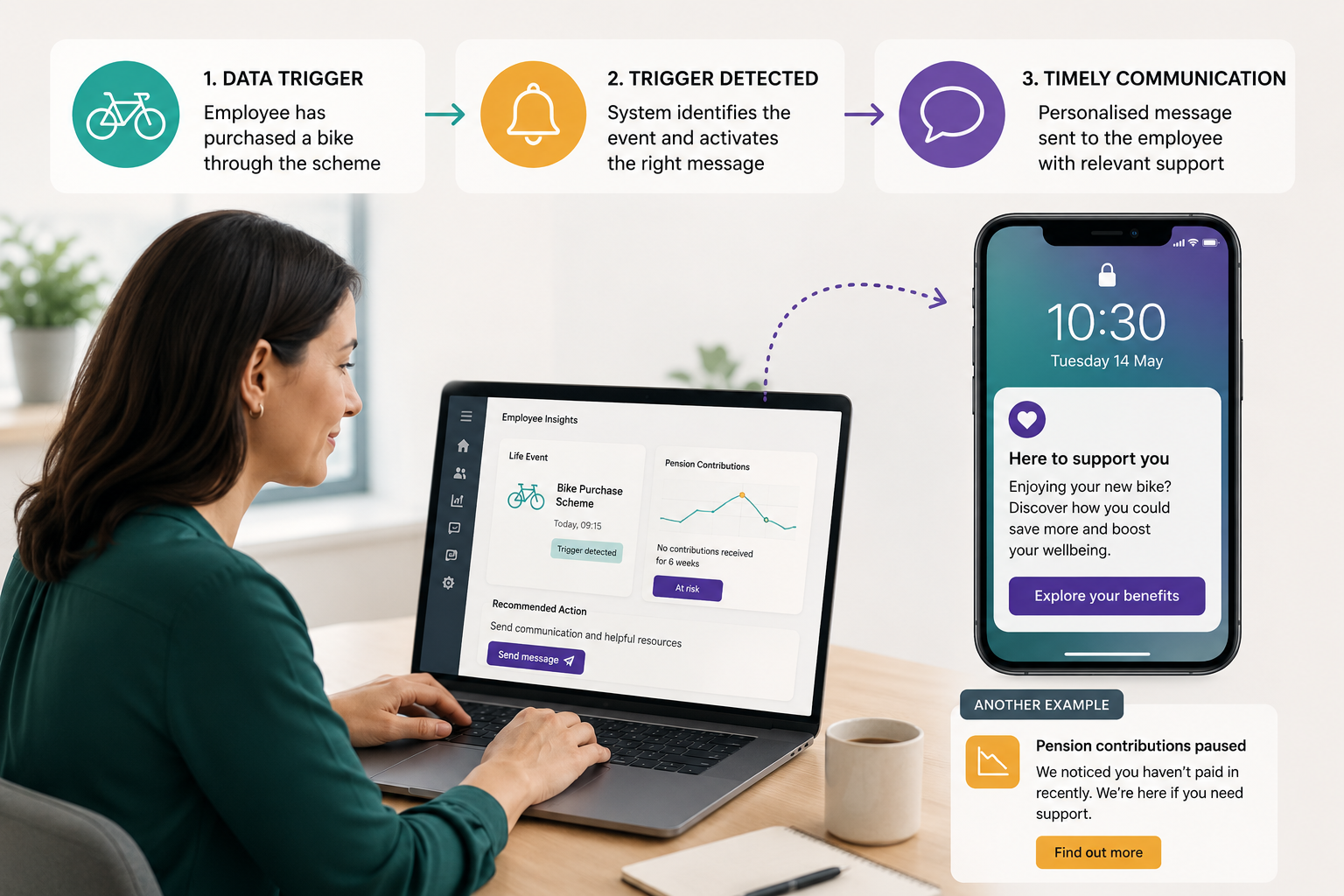
Put simply, a data trigger is an ‘if this happens, then do that’ instruction. Something changes or an employee takes an action within the platform and that triggers a response that has been set up to support the employee at that point.
Within FlexGenius, that response could be a message, an email, a short survey, or signposting to another benefit or support service.
The opportunity is not simply to automate a response, but to make that response genuinely useful to the employee. For HR teams, that means thinking carefully about how data triggers can make the benefits experience more timely, relevant and easier to navigate.
So, what does good use of data triggers look like in practice? Here are five ways data triggers can help your benefits platform work harder for both employees and HR teams.
1. Think about when information would actually be useful
We all know how easy it is for benefits communications to disappear into somebody’s inbox.
An employee may have been told about your discount platform several times, but that does not mean they are thinking about it when they sign up for Cycle to Work.
This is where timing can make a big difference.
If someone chooses a Cycle to Work benefit through FlexGenius, you could automatically let them know about relevant cycling discounts available elsewhere in their package.
You are not sending more information for the sake of it. You are giving them something useful at the point when it is most relevant to them.
That is the kind of connection a good benefits platform should be able to make.
2. Don’t assume you know what the data means
This is probably the most important point.
If somebody reduces their workplace pension contribution, FlexGenius can recognise that the change has happened, but it cannot tell you why.
It might be because money is tight, but equally, they might be paying more into a personal pension or have another perfectly sensible reason for changing their contribution.
So rather than immediately sending them financial hardship information, you could take a more sensitive approach.
For example, FlexGenius could display a message acknowledging that they have changed their contribution and invite them to answer a few optional questions. Depending on their answers, you could then point them towards pension guidance, financial wellbeing support or other information that is relevant to them.
The important thing is that you are not trying to diagnose somebody’s circumstances from one piece of data.
You are simply saying: something has changed, is there anything useful we can offer you at this point?
3. Look at what HR is doing manually
Data triggers are not only about personalisation. They can also save HR teams a lot of repetitive work.
Think about the things your team has to remember to do again and again.
Perhaps your team regularly answers the same questions about where employees can find particular benefits or information. Maybe somebody reaching five years’ service becomes entitled to an extra day of holiday and needs to be told about it.
With FlexGenius, those events can trigger the appropriate communication or action automatically.
None of these jobs sounds particularly onerous on its own. But when you are managing benefits for hundreds or thousands of employees, those little tasks add up.
One of the simplest places to start is therefore to ask your HR team: What are we spending too much time doing manually that could be automated?
4. Be careful with personal information
Of course, there are areas where you need to tread more carefully.
An employee’s age, changes to their dependants or other information within their profile may relate to very personal circumstances.
You would not, for example, want somebody to reach a particular age and suddenly receive menopause or retirement information purely because the system has decided they fit a demographic.
The same applies to fertility, caring responsibilities or changes in family circumstances.
Before setting up a trigger, ask yourself what you genuinely know from the data and what you are assuming.
Sometimes a general signpost or an optional route to more information will be enough. Sometimes it may be better not to automate the response at all.
Personalisation works best when it feels helpful, not when it feels as though HR is watching every move an employee makes.
5. Start with the questions you already get asked
If you are wondering where to begin with data triggers, do not start by trying to think of everything you could automate.
Start with the problems you already have.
What questions do employees ask your HR team over and over again? What information do people struggle to find? Which benefits are employees missing because they do not realise they are available? Where does somebody in HR regularly have to step in?
Then work backwards.
Could a message appear at the right point in the employee journey? Could a short survey help you understand what support somebody actually wants? Could FlexGenius automatically point them towards another benefit or resource?
A handful of well-chosen triggers that solve real problems will usually be far more useful than trying to automate everything.
And once you have them in place, keep checking them. Benefits change, company policies change and external rules change too, so the wording, links and surveys attached to your triggers need to stay up to date.
Make FlexGenius work harder for your people
A benefits platform should not simply be somewhere employees go once a year to make their selections.
FlexGenius can help you create a much more responsive experience by using employee actions and changes to prompt useful communications, support and automated processes at the right time.
That might mean helping an employee discover another benefit they did not know they had, giving them an easier route to guidance or simply taking a repetitive job off HR’s to-do list.
The trick is not to assume that the data gives you the whole story. It rarely does.
Instead, use it as a prompt. Look at what has happened, think about what might genuinely be useful at that moment and give the employee an easy way to take the next step if they want to.
Could data triggers make your benefits experience more useful for employees and easier to manage for HR? Talk to the FlexGenius team about the employee journeys and everyday admin challenges you would like your benefits platform to help solve.