More companies than ever are hiring across borders. Whether you're opening your first overseas office, taking on remote talent in another country, or growing through acquisition, one question comes up fast: what should your employee benefits look like once ‘local’ becomes ‘global’?
It's not as simple as rolling out your UK benefits package to every market you operate in. Benefits that work well in the UK might be irrelevant – or even illegal – in Germany or the US. This guide breaks down what global employee benefits are, how they differ from local benefits, how to build a strategy that keeps you compliant, and your reward package competitive and consistent, wherever your people are based.
What are global employee benefits?
Global employee benefits are the health, financial and wellbeing benefits a company provides to employees across more than one country. They're shaped around a shared strategy but adapted to meet local laws, market norms and employee expectations in each location.
In practice, this usually means a mix of:
- A consistent global framework: shared principles, values and, where possible, a common platform or process for administering benefits
- Local flexibility: individual benefits, contribution levels and leave entitlements tailored to what's legally required and competitive in each country
Get this balance right, and you end up with a benefits offer that feels fair and consistent company-wide, while still meeting local employee needs.
Global benefits vs local benefits: what's the difference?
A local benefits strategy is designed around a single country's laws, tax system and workforce expectations. Managing benefits in one country is simpler, but the same approach doesn't necessarily work across multiple markets. If you're hiring in five countries, you can't just copy and paste one country's package into another.
A global benefits strategy sits above all of your local benefits programmes. It defines what should be standardised everywhere, such as your overall approach to wellbeing or your employer value proposition, and what needs to flex by country, such as statutory minimums, pension contributions and healthcare provision. The goal isn't to make every package identical. It's to make sure every employee, wherever they're based, gets a package that's compliant, competitive and consistent with your company's values.
The three types of global employee benefits
Most global benefits fall into three categories. Understanding the difference matters because it determines what you're legally required to provide versus what you choose to offer.
1. Government-provided (state) benefits
These come from the state, not the employer, and include state pensions, public healthcare and unemployment support. They vary significantly by country: some governments provide extensive social safety nets, others very little, which directly affects how much an employer needs to supplement.
2. Statutory (employer-mandated) benefits
These are benefits employers are legally required to provide under local labour law, such as minimum paid holiday, sick pay, parental leave and minimum pension contributions. Getting these wrong is a compliance risk, not just a competitiveness issue.
3. Voluntary (supplemental) benefits
These are benefits an employer chooses to offer on top of the legal minimum, such as private health cover, life insurance, financial wellbeing support, lifestyle discounts and enhanced leave. This is where employers have the most opportunity to differentiate their benefits offer, and where a flexible benefits platform can add value.
What usually goes into a global benefits package?
Most global benefits strategies cover the same core categories, even if the specific benefits vary locally:
- Health and wellbeing: private medical cover, health benefits such as cash plans, dental and mental health support
- Financial protection: life assurance, income protection and other benefits that provide financial support to employees and their families when they need it
- Retirement and pensions: employer pension contributions and workplace retirement schemes, shaped by local rules
- Paid time off and family leave: statutory minimums plus enhanced holiday, parental and carer's leave
- Financial wellbeing and lifestyle support: from employee discounts and savings to financial education and advice
- Sustainable and lifestyle perks: schemes like cycle to work that also support wellbeing and environmental goals
The benefits available and the level of support offered will vary by country, but these categories provide a useful checklist to work through.
Why global benefits vary so much from country to country
Four factors explain most of the variation you'll see:
Labour law and statutory minimums: every country has its own legal requirements for employee benefits, and these can vary significantly. In the UK, most workers who work a five-day week are entitled to 28 days' paid annual leave, while minimum workplace pension contributions are generally 8%, including at least 3% from the employer. Eligible workers can also receive Statutory Sick Pay (SSP) from the first day of sickness absence.
Germany requires at least 24 days' annual leave for employees working a five-day week, while employees are generally entitled to continued pay for up to 6 weeks of sickness.
In the US, there's no general federal requirement for paid holiday or paid sick leave, although requirements vary by state and locality.
Healthcare systems: the role of employer-provided healthcare varies significantly between countries. In countries with broad statutory or public healthcare coverage, additional private health benefits may supplement existing provision. Where public healthcare is more limited, employer-sponsored health insurance often plays a much more central role.
Tax treatment: what's tax-efficient in one country may be taxed as income in another. Salary sacrifice schemes, for instance, work differently depending on local tax and social security rules. A scheme that offers significant advantages to UK employees can't simply be introduced elsewhere without review.
Culture and expectations: beyond the legal baseline, what employees value differs by market. Ask your employees what matters most to them through regular surveys, so you can shape your benefits around what your workforce values rather than relying on general assumptions.
The challenges of managing benefits across borders
Multinational employers consistently run into the same set of challenges when their benefits programmes grow organically, market by market, rather than strategically:
- Compliance risk across multiple, constantly changing sets of employment law
- Inconsistent employee experience – employees doing similar roles in different countries may feel they're being treated very differently
- Cost and administrative burden, particularly when different providers, brokers and systems are used in each country
- Difficulty benchmarking your benefits offer against competitors in each local market
This is often the point at which employers develop a global benefits strategy, rather than continuing to manage benefits separately country by country, benefit by benefit.
Five steps to a global benefits strategy that works
1. Decide what to standardise and what to localise
Set the principles that apply everywhere, such as your approach to wellbeing, your values and your minimum standard of care. Then identify which specific benefits need to flex by country to stay compliant and competitive.
2. Benchmark against local market norms
What's a strong benefits package in the UK may not stand out in another market. Research what employers in each country typically offer before setting your local packages.
3. Build compliance reviews into every market you enter
Statutory minimums change, as the UK's Statutory Sick Pay (SSP) reforms show. Build a process to track legal changes in every country you operate in, rather than reviewing benefits once and leaving them unchanged.
4. Choose technology that can flex by country
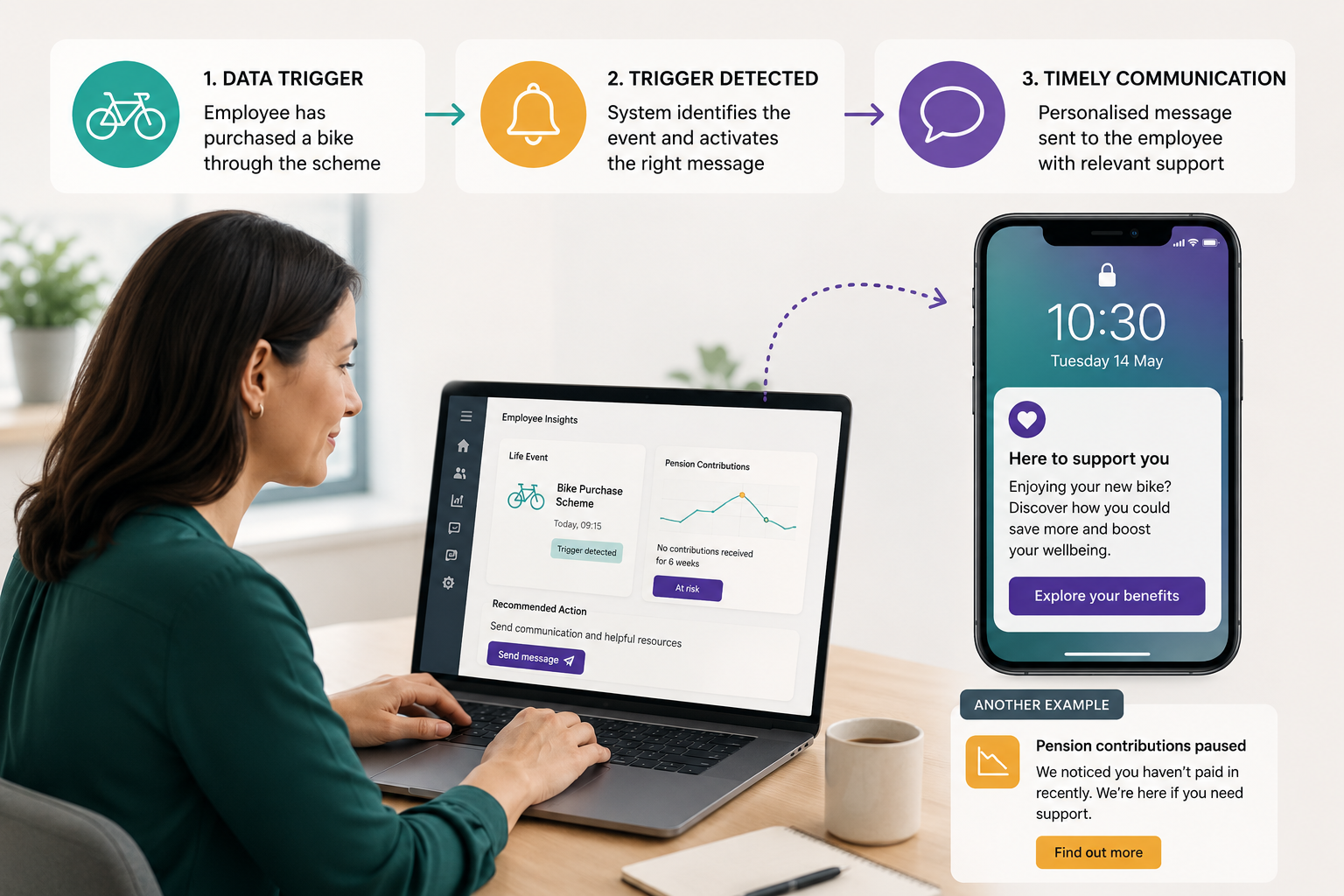
Manually administering benefits across multiple countries quickly becomes difficult to manage. A flexible employee benefits platform that can support different benefits, providers and communications by location makes administration simpler.
5. Communicate benefits clearly, market by market
A benefits package only has value if employees understand and use it. Tailor your communication, from the language and format to the examples you use, to make sense locally, not just globally.
Global benefits trends to watch
A few shifts are worth keeping an eye on as you shape your strategy:
- Financial wellbeing is becoming a baseline expectation, not a ‘nice-to-have’, as cost-of-living pressures continue to affect employees across multiple markets
- Flexible and voluntary benefits are becoming more important as employers move away from fixed, one-size-fits-all packages and look for more ways to compete for talent
- Technology and self-service are changing employee expectations of how quickly and easily they can understand and manage their benefits, wherever they're based
- DEI and family-friendly policies are increasingly considered as part of global benefits strategies, rather than treated as local add-ons
Build flexibility into your benefits strategy
A strong global benefits strategy isn't about giving every employee the same package. It's about giving every employee a package that's compliant, locally competitive and consistent with how you want to treat your people, wherever they are.
As your workforce evolves, your benefits need to evolve with it. The FlexGenius employee benefits platform helps you tailor your benefits programme to your organisation and your people. Download the brochure or book a demo to see how FlexGenius can help.